
December 2, 2025 · 6 min read
Flat roofs, saddle roofs, and the awkward ones in between
Why the same house can need three separate circuits, and how to break a complicated roof into elements the maths can handle.
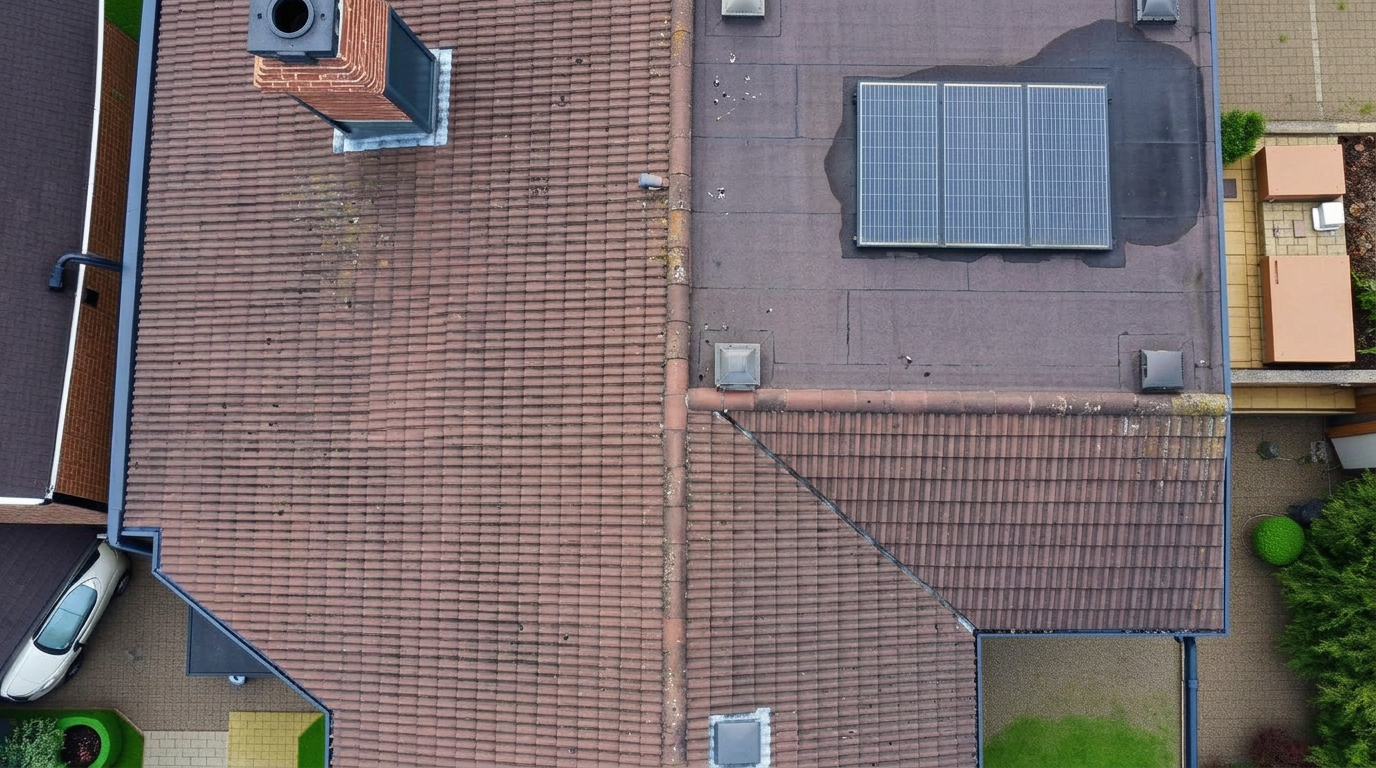
Roofs are rarely one shape. The typical house we configure is a saddle over the main volume, a flat section over an extension, and a small awkward pitch over a porch that nobody thinks about until the ember lands on it.
You do not have to measure any of it. You find your house on the satellite map, trace the outline of each building — a detached garage is simply a second building — and then trace the fence or terrace line you want as a perimeter run. From that outline the configurator derives the numbers: one nozzle per 2 m² of flat section, one per metre along a pitched roof's edges, and one every 1.5 m along a perimeter run, pointing outward as a defence line.
A saddle is protected on its edges only, because embers land on edges and gutters and that is where leaves and debris collect and ignite. That is also why a pitched roof of the same footprint needs fewer nozzles than a flat one of the same size, and why the two mix cleanly on one house.
The limits are simple and they are not arbitrary. One tap drives one circuit, and a circuit stops at 50 nozzles and 50 m of tube, because past that the last nozzles no longer get enough pressure for an even spray. Every building and every perimeter run starts from its own tap, and when a building needs more than one circuit the configurator adds a tap by itself. You never split anything by hand.
Tube is estimated from the traced geometry rather than paced out, and we add ten percent on top and say so, because tube follows edges and corners rather than straight lines. If a tap does not sit near the roof, you can add a garden hose to bridge the gap in one of six colours chosen to blend into a facade.
Work out what your own roof needs.
Open the configurator